Articles on fraud and AML monitoring. For releases and product news, see News.
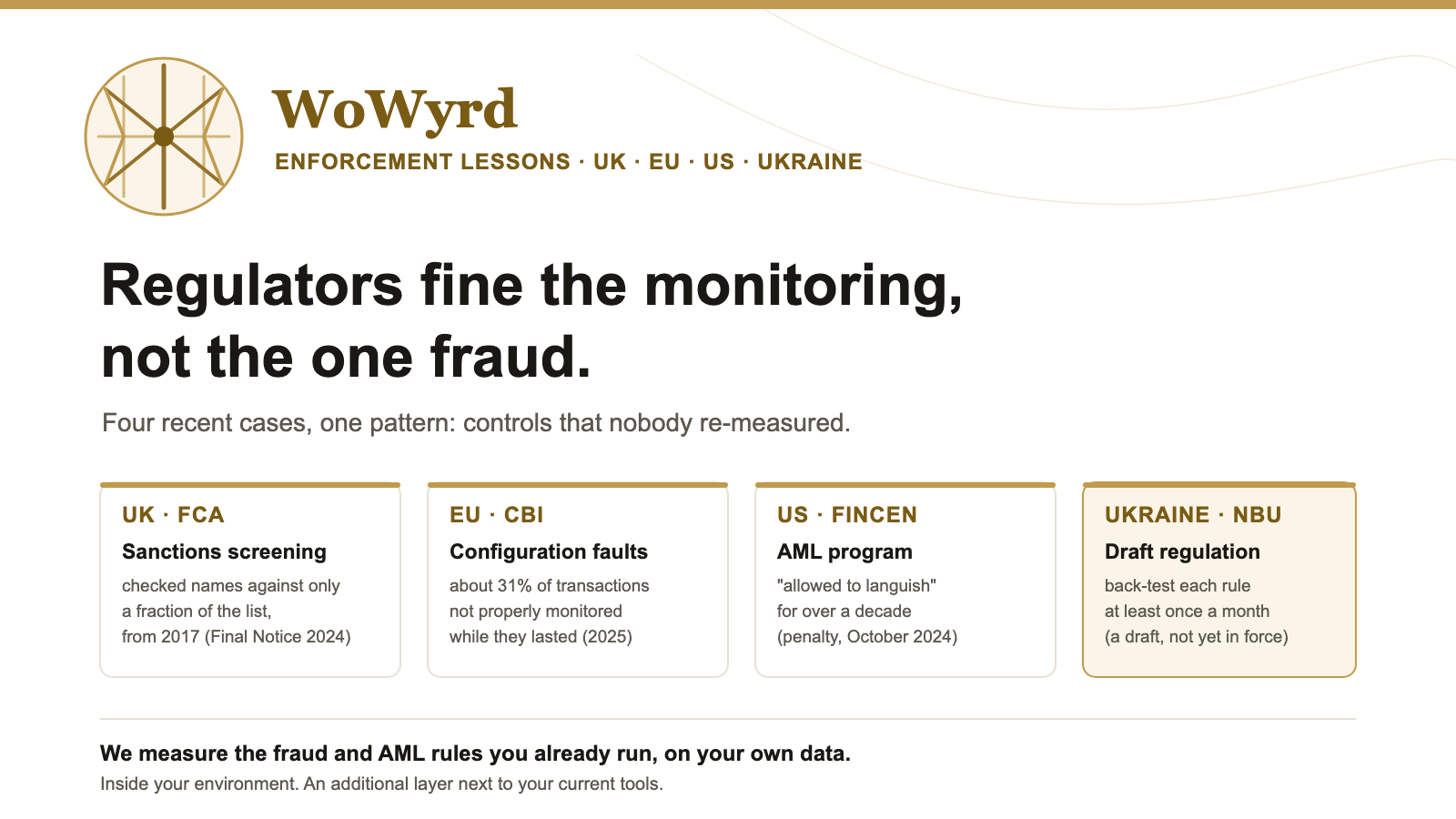
Regulators fine the monitoring, not the one fraud
Most financial-crime fines are not for one fraud that got through. They are for monitoring that nobody
re-measured.
Four recent cases from four jurisdictions show the same pattern.
UK. In January 2023, Starling Bank found that since 2017 its automated sanctions
screening had checked customers against only "a fraction of the names on the Consolidated List". Its own
review then found wider issues, including the "testing and calibration of screening systems, and a lack of
MI regarding alert volumes and trends". The FCA fined it £28,959,426 for this and other financial-crime
control failings (Final Notice, 27 September 2024).
EU. The Central Bank of Ireland fined Coinbase Europe €21,464,734 (6 November 2025).
Faults "in the configuration of their transaction monitoring system" meant 30,442,437 transactions, worth
over €176 billion, were not properly monitored. That was about 31% of its transactions while the faults
existed. Re-monitoring took almost three years and led to 2,708 suspicious transaction reports.
US. FinCEN's record $1.3 billion penalty against TD Bank (10 October 2024) says: "For
over a decade, TD Bank allowed its AML program to languish." In FinCEN's words, the bank "allowed trillions
of dollars in transactions annually to go unmonitored".
Ukraine. In 2025 the NBU made 46 decisions to fine banks, UAH 426,292,735 in total, and
59 decisions to fine other institutions, UAH 159,897,206 in total. These were for breaches of
financial-monitoring, currency and sanctions law (NBU Annual Report 2025). The NBU's draft regulation on the
control of payment operations goes further: it asks payment providers to review each rule by back-testing
at least once a month. It is still a draft.
The pattern is simple. A rule or a scenario is set up once. Then the business, the data and the lists
change. Nobody checks if the control still does its job, until a regulator or an incident does.
So the useful question is not only "why did we miss this payment?" It is "how do we know our monitoring
still works?"
This is the question WoWyrd answers with your own data. We measure the fraud and AML rules you already
run, inside your own environment. We replay your rules and compare the result with what your engine
actually logged. The report shows which rules fire for nothing, what they miss, and which thresholds to retune.
It is an additional layer next to your
current tools. If your rules do their job, the report says so.
Your data stays with you.
And if your team already re-measures its rules: how often, and what made you start?
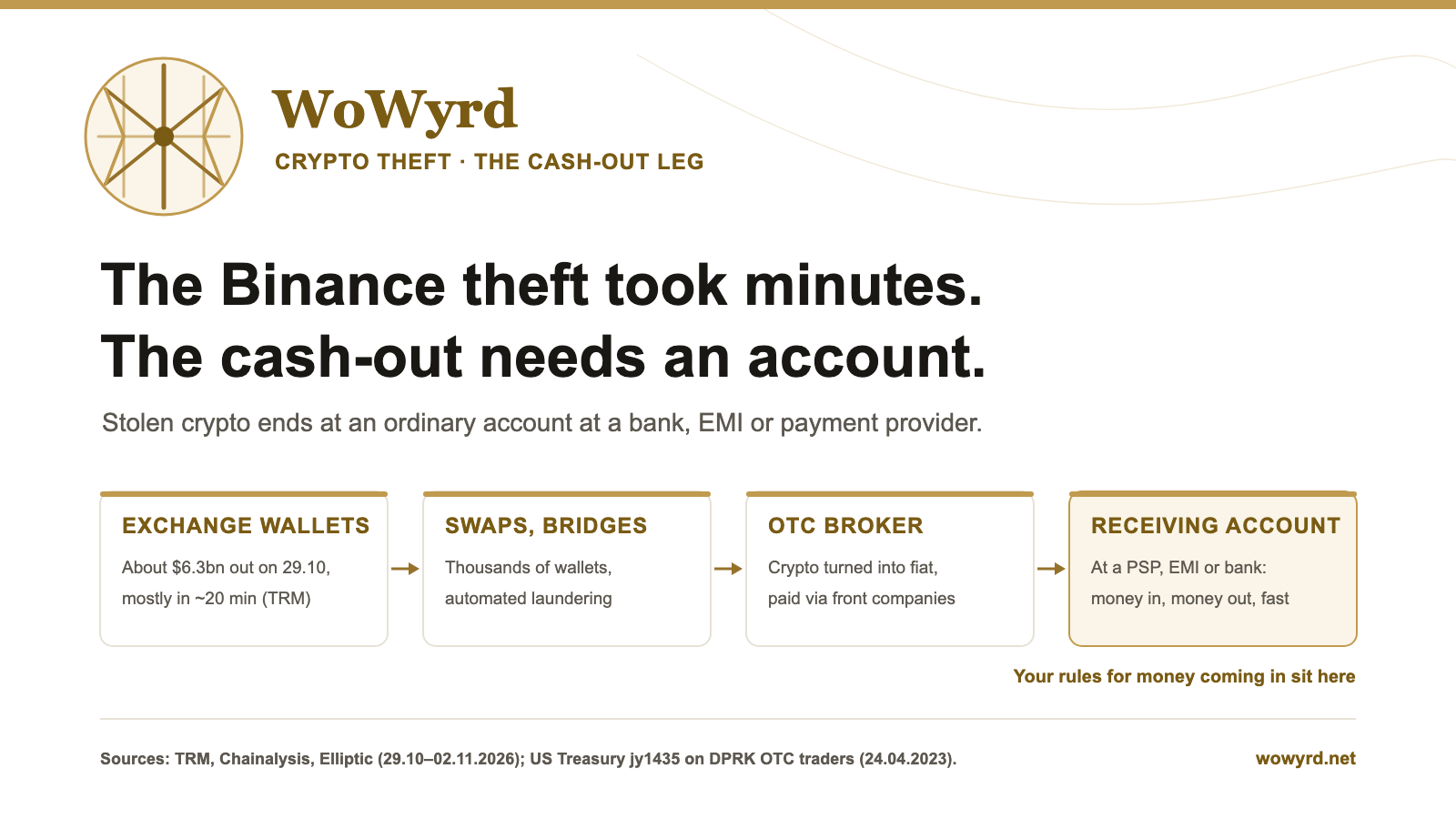
The Binance theft took minutes. The cash-out needs an account.
First published on LinkedIn on 2 November 2026. Figures are as of that date.
About $6.3 billion left Binance on 29 October. Most of it moved in about 20 minutes (TRM Labs).
The FBI has attributed the theft to North Korea.
Industry partners froze a large part fast. As of 2 November, Elliptic counted $2.85 billion frozen or seized. About $3.28 billion was still under the thieves' control, and only a negligible amount appeared to have been converted to cash.
So the hard part for the thieves was still ahead: turning crypto into money they can spend.
Public records show how that has worked before:
After the 2025 Bybit theft, the FBI wrote that the funds "will be further laundered and eventually converted to fiat currency" (FBI IC3, 26.02.2025).
In 2023 the US Treasury sanctioned two OTC crypto traders. One converted crypto stolen by North Korean actors into fiat, with payments to companies, including front companies (Treasury, 24.04.2023).
On 30 October, Chainalysis and TRM Labs told CNBC that hackers increasingly use professional laundering networks, including OTC buyers, to get to fiat.
At the end of that chain is an ordinary account at a bank, an EMI or a payment provider. Money arrives from a broker or a "trading company" and moves on. The FCA's draft guidance describes the mule pattern as "rapid dispersal of funds through networks of accounts (often within minutes of receipt)".
To be clear: we do not protect an exchange's wallets, and we do not trace coins on a blockchain. Chain-analytics tools do that.
The question for the firm that holds that receiving account: do your rules for money coming in fire on this pattern, and how often do they fire for nothing? We measure the fraud and AML rules you already run, on your own data, inside your environment.
If you own fraud or financial-crime risk at a PSP, EMI or bank: when money from a crypto off-ramp lands in one of your accounts, what do you see first?
The FCA reviewed 35 UK banks, building societies, payment institutions and e-money institutions. Its findings, published on 23 September 2026:
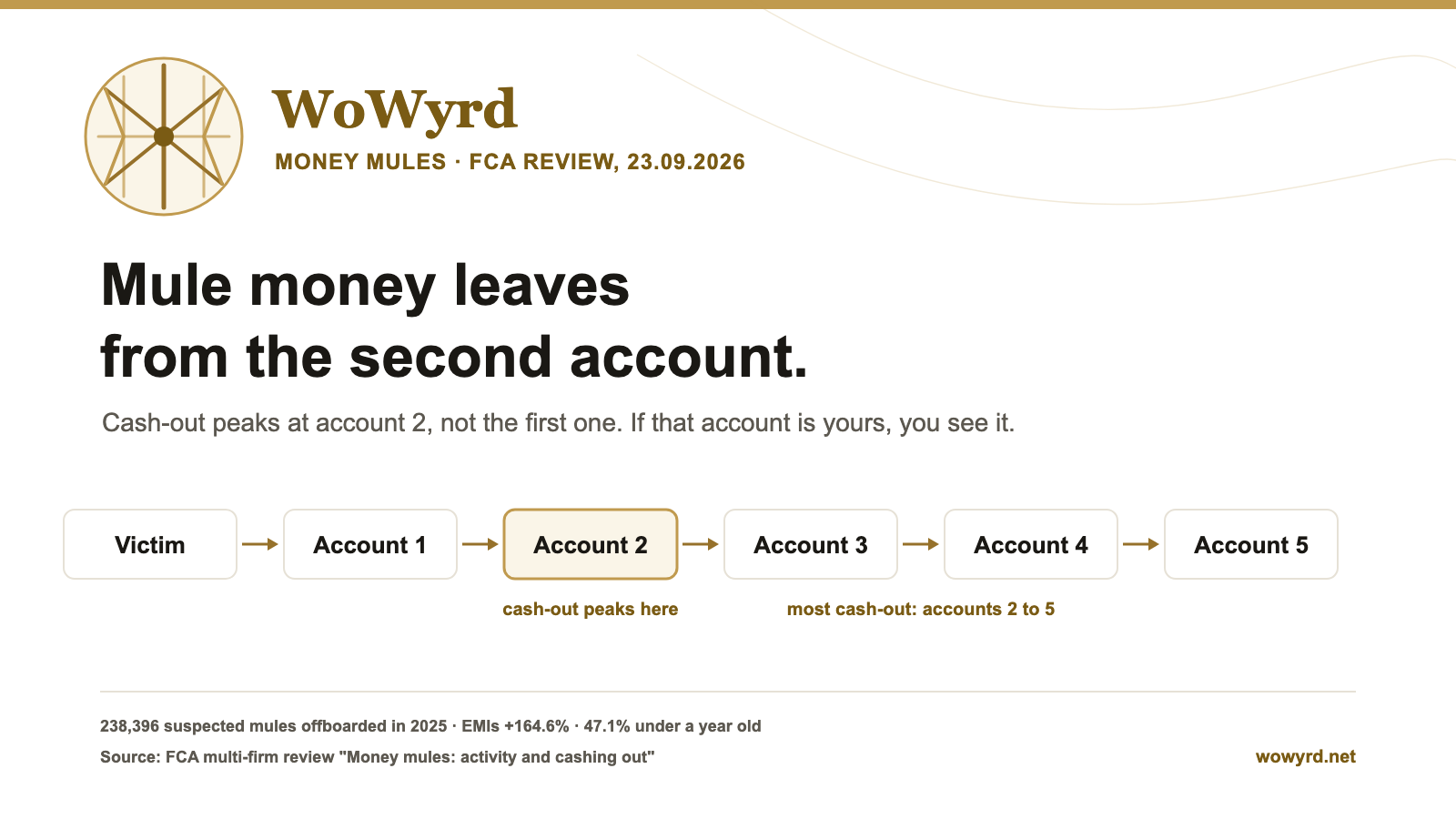
Firms offboarded 238,396 suspected mule accounts in 2025, up from 184,935 in 2023.
E-money institutions had the largest rise: 164.6% compared with 2024.
47.1% of the offboarded accounts were less than a year old.
Cash-out was "mainly concentrated between the second and fifth mule accounts", and it peaked at the second.
Card payments were the most common cash-out method.
The FCA's message to firms: look beyond the initial receiving account.
That second account is someone's customer. If it's yours, you are the one place that sees the money arrive and leave. In the UK, you also pay half of the victim's refund when you receive APP scam money. In Ukraine, parliament adopted bill No. 16013 on "drops" on 28 October 2026, and the NBU calls banks the first line of defence.
So the question for a receiving firm is simple: do your rules for money coming in fire on this pattern, and how often do they fire for nothing? We measure the fraud and AML rules you already run, on your own data, inside your environment.
One honest limit: one firm sees only its own link in the chain. Seeing the whole chain takes information sharing between firms, which is where the FCA points too.
If you work at an EMI or a PSP: when money lands and leaves within minutes, who looks at it first, and how soon?
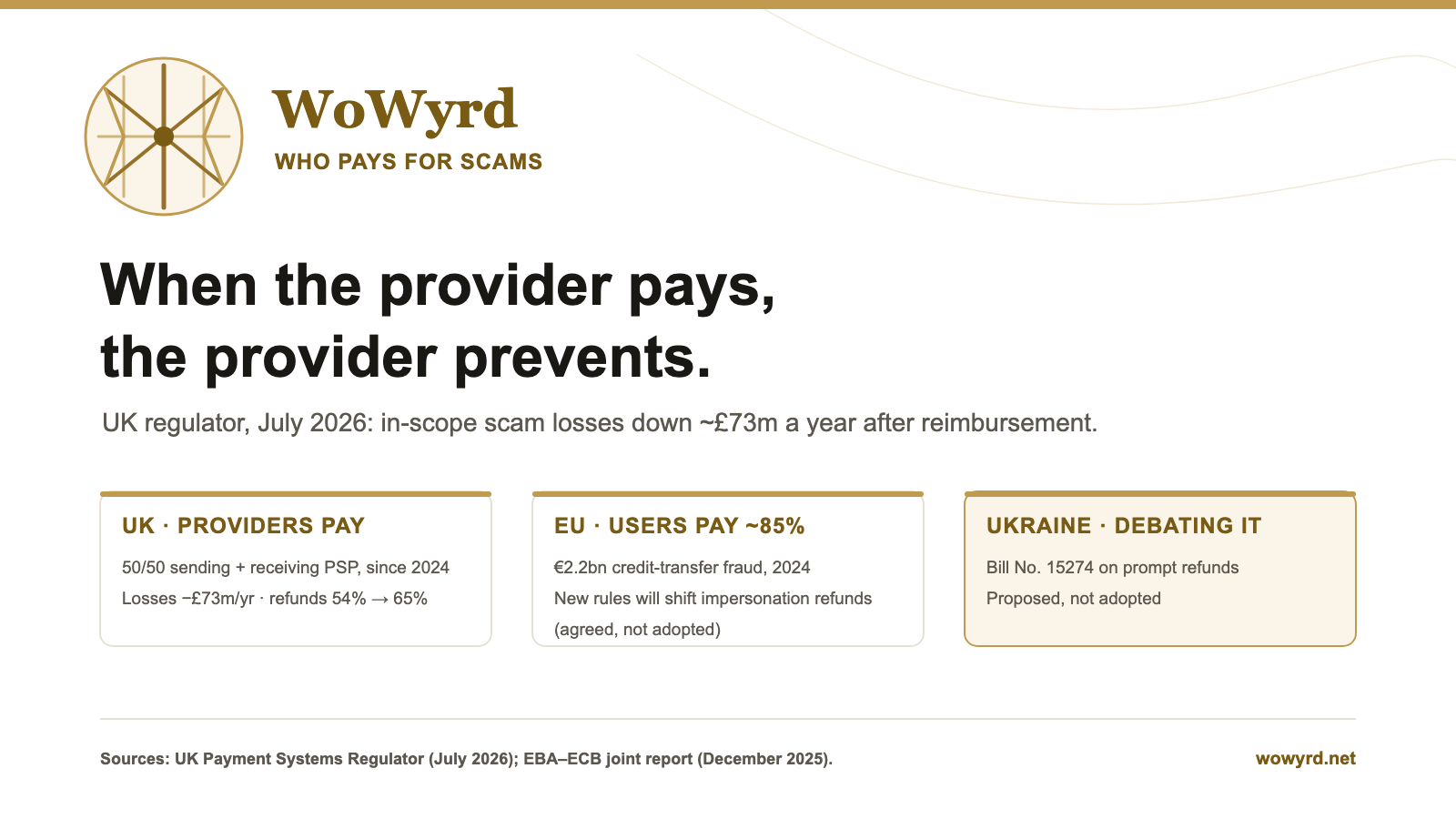
Who pays when a customer is talked into sending money to a scammer?
In the UK, since October 2024, the answer is the payment providers: the sending and the receiving firm split the refund 50/50. In July 2026 the UK Payment Systems Regulator published an independent evaluation of the first year. In-scope scam losses fell by an estimated £73 million a year. Nearly 35,000 fewer people were scammed. The share of claims reimbursed rose from 54% to 65%. The regulator's line: firms are investing in prevention.
In the EU, users still carried about 85% of credit-transfer fraud losses in 2024, €2.2 billion in total (EBA–ECB joint report). The new Payment Services Regulation was politically agreed in November 2025 and is not yet adopted. When it applies, it will move part of that onto providers: refunds when a scammer impersonates the bank, and liability where prevention was inadequate.
In Ukraine, bill No. 15274 proposes prompt refunds for fraudulent operations. It is a proposal, not a law, and the banks' association opposes it. The direction is the same.
The pattern is simple: when the provider pays for the scam, the provider starts stopping it before the money moves. Refunds after the fact are expensive. A pause before the payment is cheap.
A pause only helps if the rules behind it fire on the right payments. We measure the fraud and AML rules you already run, on your own data, inside your environment.
If you run fraud at a payment provider in the UK or the EU: what changed in your team once reimbursement became your cost?