How your fraud rules perform, measured on your own data.
WoWyrd measures how the fraud rules you already run perform on your own data, inside your own environment. It shows which rules to retire, merge, retune or add, with the effect in your own costs.
It works from files your current rule engine can export. It changes nothing in your engine.
Or request a pilot, or get a free requirements map for your licence.
New in release v0.7.0: a vulnerability scan before signing, cosign 3, and fewer small numbers in shared reports.
Three steps, inside your perimeter
-
Files your engine already exportsYour transactions, your engine's decisions and rule hits, your confirmed fraud and your unit costs.
-
The review runs inside your perimeterThe collector runs in your environment, on your files. Nothing changes in your engine.
-
Two reports from one runA technical report for your rule team and a short management report.

What the review gives your team
Per rule: keep, tune or retire
Hits, precision, overlap with other rules and decay over time, with a proposal, its evidence and its caveats. A new threshold is proposed only if it wins on both the earlier and the later part of your history.
Requirement → rule → metric
Your rules, mapped to what your regulators require. Each requirement has its official source and an "as of" date.
What changed since the last review
From the second report on, at least 29 days later: what changed in your rules and their metrics, and which requirements are still open.
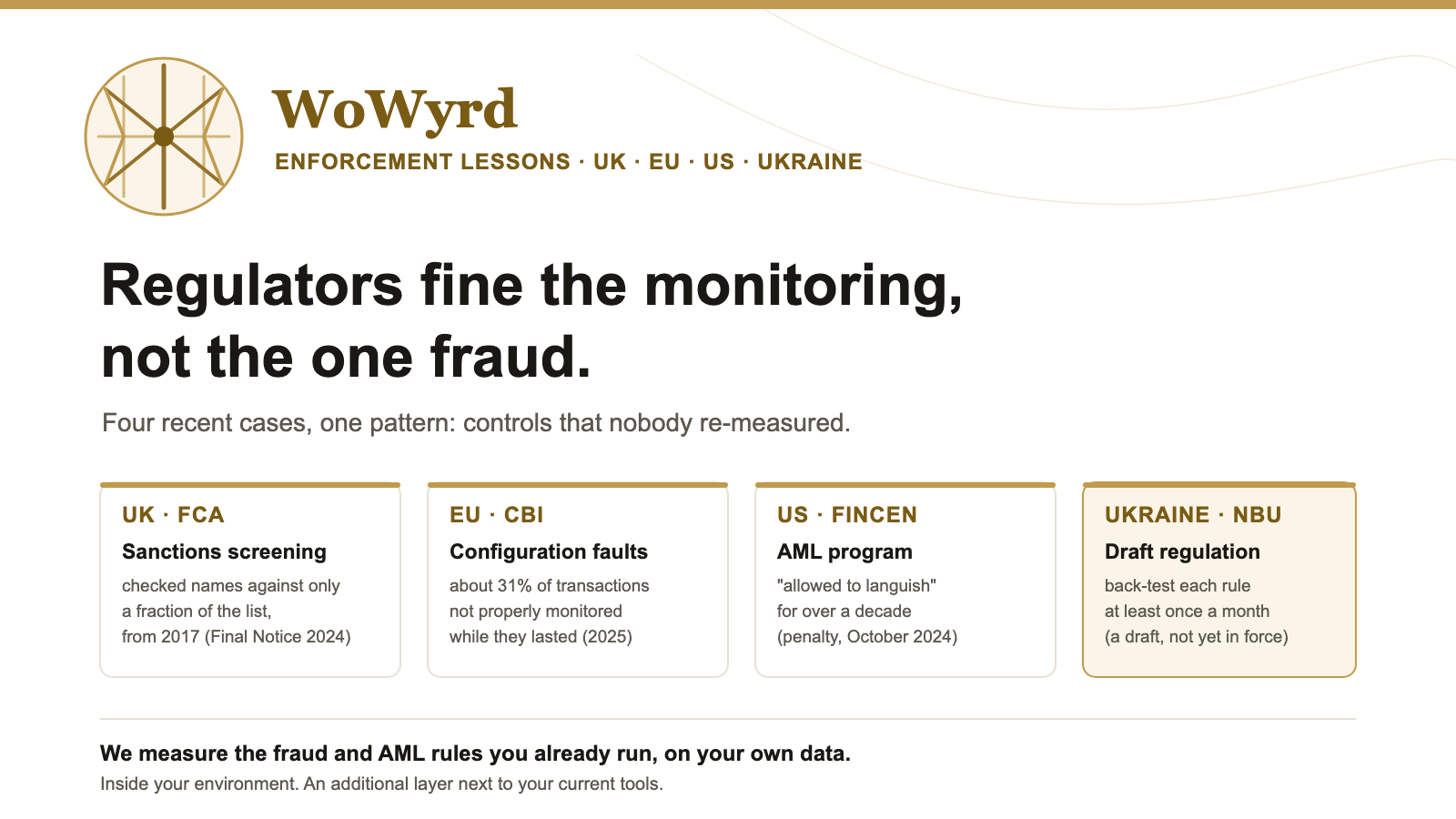
Regulators expect rule testing
- Ukraine · in force
NBU Resolution No. 58
Every month, a fraud-rate ratio for each type of remote payment. Two quarters in a row above the reference ratio, and the exemption from strong authentication is lost for that type.
- Ukraine · draft
NBU draft of 17.07.2026
A monthly backtest of every rule, two effectiveness metrics, written thresholds, and a decision to keep, adjust or cancel each rule. The text is still a draft.
- EU · from 10.07.2027
AMLR Article 9(2)(b)
An independent audit function, or an external expert, tests the AML policies, procedures and controls. Our report can serve as evidence for that test.
- United States · in force
NYDFS Part 504
Ongoing analysis of rules and thresholds. The FFIEC BSA/AML manual expects documented threshold tuning.
This is not legal advice. Your legal and compliance teams decide what a requirement means for you.
-
Your data stays with youThe reports stay in your environment. The summary export holds totals only: it hides counts under 10 and refuses to write if it finds an identifier.
-
Signed releasesReleases are signed with cosign. Your team checks the rule-review image offline before loading it.
-
If your rules work, we say soThe review only observes: it proposes, and your team decides. If your current tools are enough, we will tell you.
Measure your rules on your own data.
A first 20-minute call about how you review your rules today. Then a pilot: the collector runs in your environment, and we go through both reports with you.